The Blueprint of Heartbreak: Why Your Inner Child Keeps Choosing Familiar Pain Over Unfamiliar Peace
Take a look at your relationship history. If you are currently wading through the grueling waters of chronic singlehood, or if you are picking up the pieces of an agonizing divorce, it is incredibly easy to point fingers outward. We blame the toxic dating culture. We blame the addictive, superficial nature of dating apps. We blame an entire generation of people who seem pathologically incapable of commitment.
We tell our friends over drinks that "there are simply no good ones left."
It is a comforting narrative. It absolves us of agency, wrapping us in the protective blanket of victimhood. But if you step back and look at the wreckage with absolute, unblinking honesty, a uncomfortable pattern usually emerges. The faces change, the names change, and the locations change—but the script stays exactly the same.
You keep attracting partners who love-bomb you and then vanish into thin air.
You keep finding yourself playing the role of the therapist, fixer, or emotional caretaker.
You consistently end up with people who make you beg for the bare minimum of attention.
If the same story keeps happening to you with different people, it is time to put down the magnifying glass and pick up a mirror.
Repetitive relationship failures, chronic singlehood, and devastating divorces are rarely a product of "bad luck" or a toxic dating market. Instead, they are the unconscious reenactments of your unmet childhood needs. Your adult self wants peace, stability, and love. But your subconscious mind—driven by a wounded inner child—continually chooses familiar pain over unfamiliar peace.
Until you understand the invisible blueprint directing your romantic choices, you will keep building the exact same house of cards.
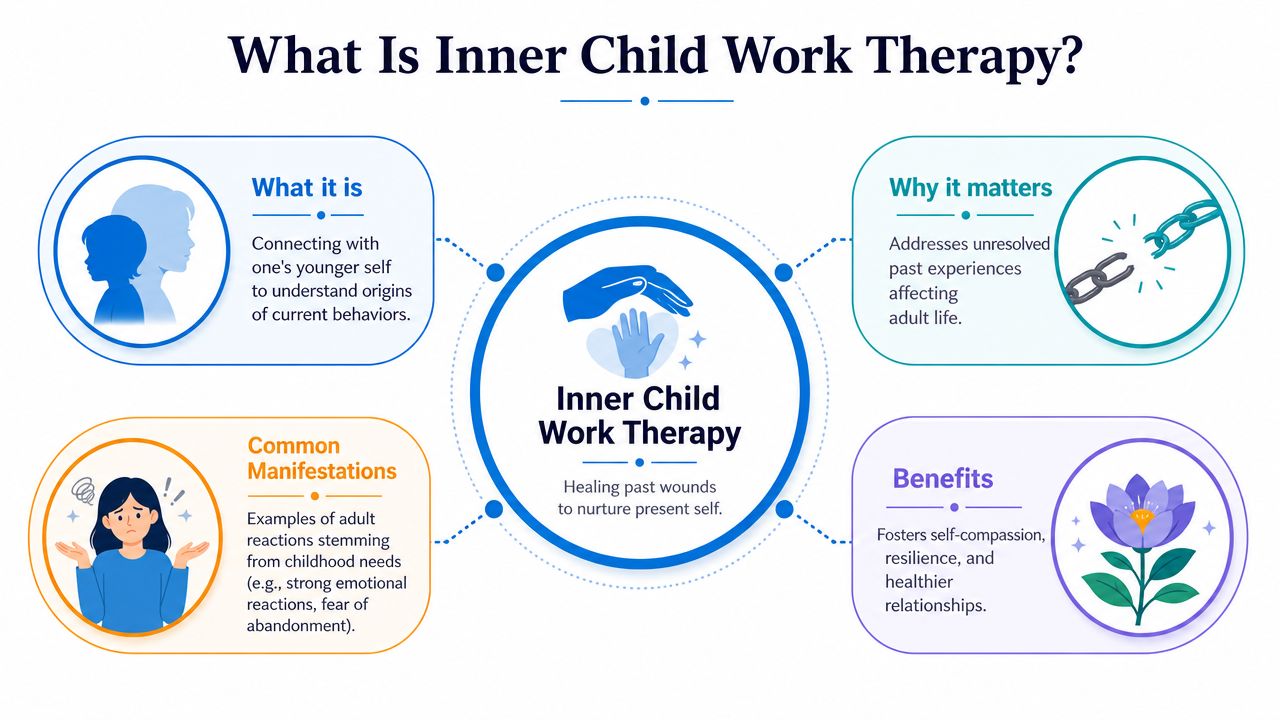
The Invisible Passenger: What is the "Inner Child"?
To understand why your romantic life feels like a recurring loop of a bad movie, we have to look at who is actually driving the car.
When psychologists talk about the "Inner Child," they aren't engaging in mystical, woo-woo pseudoscience. They are referring to a very real, highly active layer of your subconscious mind.
Between the ages of 0 and 7, the human brain operates primarily in alpha and theta brainwave states. This is essentially a hypnotic state of hyper-suggestibility. Children do not have a fully developed rational mind to filter, analyze, or reject the information they receive. Instead, they act like emotional sponges, absorbing every look, every sigh, every conflict, and every absence of their primary caregivers.
During these formative years, you formed your foundational relational blueprint. You learned:
What love feels like.
What you have to do to get it.
Whether it is safe to depend on others.
Whether you are fundamentally worthy of care.
``
[Childhood Experience] ──> [Subconscious Blueprint] ──> [Adult Romantic Choices]
``
If your parents were emotionally mature, consistent, and validating, you likely developed a secure attachment style. You learned that love is stable, safe, and predictable.
But what if your childhood looked different? What if your parents were emotionally unavailable, overly critical, volatile, or highly conditional with their affection? What if you had to perform, stay quiet, or become "the good kid" just to receive a shred of positive attention?
In those moments, your young mind didn't conclude that your parents were flawed human beings doing their best. Children cannot afford that realization; to a child, a flawed caregiver means certain death. Instead, the child concludes: “There is something wrong with me. I am not enough as I am. I must alter who I am to keep them close.”
This survival strategy becomes a permanent file in your subconscious software. When you grow up, put on a suit, and enter the adult dating market, that wounded, terrified child does not disappear. They become an invisible passenger, sitting in the passenger seat of your life—and all too often, grabbing the steering wheel when it comes to love.
The Anatomy of the Loop: Why We Crave Familiar Misery
The human brain is a master of survival, but it has one major flaw: it equates familiarity with safety.
To your primitive subconscious mind, anything that is familiar is predictable, and anything that is predictable is survivable. Conversely, anything that is unfamiliar—even if it is objectively healthy, beautiful, and peaceful—presents an unknown danger.
This is the psychological mechanism behind what Sigmund Freud called repetition compulsion. It explains why adults who were raised by an alcoholic parent often marry alcoholics. It explains why people who were chronically abandoned by busy parents consistently date partners who cannot prioritize them.
The Subconscious Paradox: The inner child does not seek a partner who will treat them well. The inner child seeks a partner who will treat them in a way that matches their original childhood coding, because that is the only environment they know how to navigate.
Let’s look at how this plays out in real-world dating dynamics.
Case Study A: The Chase for the Unavailable
Imagine a child whose father was distant, workaholic, and emotionally cold. The child spent their entire youth bending over backward to get dad to notice them—getting straight A's, excelling at sports, being perfectly well-behaved. Occasionally, they would get a crumb of validation.
Fast forward twenty-five years. This person is now a highly successful, brilliant adult. Yet, their dating history is a graveyard of emotionally unavailable, avoidant partners.
When they meet someone who is emotionally stable, communicative, and ready for commitment, they feel absolutely no spark. They label this healthy person as "boring" or "lacking chemistry." But the moment they meet someone who is aloof, mysterious, and inconsistent, their brain lights up like a Christmas tree.
They mistake the anxiety of chasing someone for "passion." In reality, their inner child has spotted a proxy for their father. The inner child’s unconscious logic is simple: "If I can finally force this emotionally cold person to love me, I will finally prove that I am worthy. I will fix the original wound."
Case Study B: The Failsafe of Isolation
Now consider a child who grew up in a chaotic household where love was highly volatile. One minute mom was affectionate; the next, she was screaming or threatening to leave. The child learned that intimacy is a trap. To get close to someone is to invite inevitable pain, betrayal, and suffocation.
As an adult, this person becomes the poster child for chronic singlehood. They claim they want a relationship, but they always find a flaw in every candidate. This one laughs too loudly; that one doesn't have the right career; the other one lives forty minutes away.
They use hyper-criticism as an emotional shield. By keeping everyone at arm’s length, the inner child successfully protects themselves from the terrifying vulnerability of being seen and abandoned. They choose the safe, predictable pain of loneliness over the terrifying risk of unfamiliar intimacy.
Breaking the Spell: Moving from Victim to Sovereign
If you are realizing that your inner child has been running your romantic life, the first instinct is often self-blame or despair. You might look back at your failed marriage or your years of empty dating app swiping and feel a profound sense of regret.
But this realization is actually the moment your freedom begins.
You cannot fix a problem you do not know exists. As long as you believe your relationship issues are a result of bad luck or a terrible dating pool, you are powerless. You are entirely dependent on the universe magically dropping a perfect human being onto your doorstep.
But when you realize that your relationships are a reflection of your internal blueprint, the power shifts entirely back into your hands. You stop being a victim of the dating market and become the sovereign creator of your emotional life.
To break the loop, you must transition from acting as the wounded child to acting as the Wise Adult who observes the child.
| The Wounded Child's Narrative | The Wise Adult's Reality |
|---|---|
| "They didn't text me back for four hours. They are going to leave me because I am fundamentally unlovable." | "They are likely busy. My worth is completely independent of their response time. I am safe regardless." |
| "This person is so stable and consistent. There's just no spark here. I feel completely bored." | "I am confusing a lack of anxiety with a lack of chemistry. Peace feels boring to a nervous system wired for chaos." |
| "I can change them. If I just love them enough and support them, they will finally open up to me." | "I am trying to play the savior so I don't have to face my own emptiness. I cannot heal someone who does not want to change." |
When you begin to heal your inner child, your definition of "chemistry" changes. You stop being attracted to the highs and lows of the emotional roller coaster. Chaos stops looking like passion, and stability stops looking like boredom. You begin to crave peace.
Your First Act of Rebellion: Tracing the Thread
Healing your inner child is a journey that requires time, patience, and often professional guidance. However, you can begin rewriting your blueprint today by conducting a radical inventory of your past relationship failures.
Take a piece of paper and draw three parallel columns.
Column 1: The Exes. List the last three to five people you dated seriously, married, or intensely chased.
Column 2: The Core Grievance. Write down the primary emotional complaint you had about each person. (e.g., "He made me feel invisible," "She was hyper-critical and never satisfied," "They always kept one foot out the door.")
Column 3: The Childhood Echo. Look at those grievances honestly. Where did you first feel that exact flavor of emotional pain in your early life? Which parent or caregiver made you feel invisible, criticized, or unsafe?
Look at the paper. Notice how the lines cross. Notice how the patterns repeat.
The next time you are out on a date and you feel that overwhelming, obsessive, intoxicating "spark" with someone who seems a little bit distant, pause. Take a deep, grounding breath. Put your hand over your heart and speak silently to that younger version of yourself.
"I see you. I know you recognize this pain. I know you want to jump back into the fire to prove we can survive it this time. But we don't have to play this game anymore. I am the adult now, and I am going to keep us safe."
You cannot build a healthy, mature relationship with another person until you have mended the relationship with the child inside of you. Stop looking for the right partner, and start focusing on being the right caregiver to yourself. When your inner child finally feels safe, seen, and protected by you, they will stop looking for toxic mirrors in the outside world. Secure love will no longer feel unfamiliar—it will finally feel like home.